Wednesday, April 30, 2014

What's Wrong With Being a Racist???


Well as I sit at my desk there are at least four articles on yahoo headlines that are focused on Donald Sterling and his off the collar remarks. I partook in a very lively debate a few days ago on my Cousin’s Will’s wall and a few other buddies that I have, we briefly spoke/posted about it. Now anyone who knows me knows I don’t shy away from controversy nor do I seek it out. However I am a strong, very independent and free thinking man and I’m not afraid if my view point doesn’t mirror up with anyone else’s…and I do mean anyone. I like getting folks to think not only about themselves but about how we act and what we do vs. don’t do within our society.

Alright let’s talk about racists. Now, let me say this…if you’re uncomfortable with this discussion or the subject in general, I’d suggest you stop reading now. But if you’re curious and interested in what I am gonna talk about, keep on reading. And if you’re gonna read I ask you to do just one thing, LISTEN FOR UNDERSTANDING….NOT AGREEMENT. Ok, before I get started, I wanna throw out a few definitions so that you can refer back to them as I continue with the discussion

RACE: A division of human beings identified by the possession of traits that are transmissible by descent and are sufficient to characterize persons possessing these traits as a distinctive human genotype.(in other words your GENEs make up your race not skin color)

RACISM: Maybe viewed as an attitude, action (conscious or unconscious), or institutional structure, that subordinates an individual or group because of skin color or race.

RACIST: A person with a prejudiced belief that one race is superior to others.

BIGOT: One who is strongly partial to one’s group, religion, race, or politics and is intolerant of those who differ.

PERSONAL/INDIVIDUAL RACISM: Prejudicial beliefs & discriminatory behavior of a bigot against an individual or group.

RACIAL PREJUDICE: Racial prejudice is a feeling or dislike based upon a faulty and inflexible generalization due to race. Prejudice may be felt or expressed. It may be directed toward an individual or group.

INSTITUTIONAL RACISM: The policies, practices, actions or procedures of military communities, schools, businesses, and other groups/organizations that restrict the opportunities of an individual or group and violates the statutory laws prohibiting such wrongs.

Ok, that was a mouthful. So let’s get back to the title of this. What is wrong with being a racist? And I’m asking this question honestly because I wonder how many people have really looked at just what is a racist. You see in our society we love to use the economizing phenomenon and instead of educating ourselves before we make a judgment we use this perceptual concept, which is the mind’s ability to take in new information, combine it with old information, and formulate new ideas through quick deduction.  It’s sort of a “quick fix” that happens when we don’t have time to fully analyze the new information.  When you hear certain words in our societal vocabulary they instinctively cause reactions in certain situations. Words like racism, sexist, homo, faggot, fag, nigger, bitch, wetback, asshole, rapist, gook, Oreo, etc. etc are imbedded within our culture as some, regardless of the definition, these words and others have taken on a life of their own. Some are positive while most are negative.  So generally when you hear or witness one being used you immediately fill in the missing information and your opinion and perception are formed; especially if a person has used it and directed it at another.

                In America we pride ourselves on being free and all things associated with being free and having freedom. Free to be just what we want and or believe in what we want. Whether it’s free speech or the right to bear arms most Americans fully believe in the principles associated with freedom and go to great lengths to show their support for them. Whether it’s 20 guns locked in your gun safe or a front yard full of cars, this is America and you’re free to do it. This freedom and freedom of speech includes protests, petitions, sit-ins, boycotts just to name a few. The irony to having all these freedoms is…you really aren’t free. We all, on paper have the same freedoms but in reality we don’t.

                Let’s take one such freedom that many Americans CLAIM they will go to jail for and almost die for; that freedom being free speech. The premise of free speech is that it’s a constitutional right and we have the right to use it. Freedom of speech in this country is protected by the First Amendment to the United States Constitution and by many state constitutions and state and federal laws. Knowing this, many Americans feel they have a right to say what they wish because…the constitution says so. So if you call someone say an asshole it’s seemingly protected and you have the right to do so. You also have the right to say the President is a dumbass and not be sent to the “Gulag” for it. But with any freedom we tend to overdo them at times. Well, I guess that’s as good a foundation as I need. Hell, all of you who are reading this have at least a grade school education and enough time walking on this earth to have experienced some of life’s challenges so I need not go any farther.

                This leads me back to my topic. So why can’t a person be a racist if they choose too? And why are we ignoring the definition of that word and only applying it to people we want too? Most of the time when we think of a Racist we think of a Klan member or some other white person who hates and despises anyone who isn’t “white” just like them (whatever that “white” maybe). But when there is someone who is non-white and expresses a view that’s identical or very, very similar many in our society and the media rationalize the behavior and label it something else. If an Asian parent feels that their son marrying a Hispanic female is BENEATH them…then these Asian parents are indeed racist. You could also call them bigots. Why don’t we call them racist? Oh, yeah, because they aren’t white. Because we have been programmed and socialized to believe that racists are white. We will rationalize that the Asian parents only want the best for their son and that they just want their son to marry a “good” Asian girl. This very attitude and behavior can be seen within all the ethnic groups across America.  What I’m saying is that on any given day we hear, witness and truth be told probably partake in some action(s) that is racist. But because of the perception and stereotype associated with that word, we excuse the behavior of our friends, family members and ourselves; instead of calling them out on those behaviors and actions. This reminds me of the whole Chic-Fil-A incident a few years ago. Same type of thing. A person expressed their personal views and were attacked for it.

                Donald Sterling probably is a racist but is that a crime? Nope. I have read that he paid a $3 million dollar fine for denying housing to blacks stating that “they smelled and attracted vermin.” Who the hell says VERMIN? LOL. Anyhoo, denying housing is a crime; he was found guilty or given a plea deal and paid up and I support that 100%. But if you are simply stating that you don’t like someone based on their skin color yet you don’t act on it or discriminate…what’s the problem? People do this every single day and many of you say nothing. Many of you will walk passed an interracial couple and cut your eyes or make comments. Really? And you got issues with Sterling too. We are heading down a slippery slope when we start attacking folks for their own personal views especially IF THEY AREN'T ACTING ON THEM. Again, not talking about those that do act on them. Sterling apparently has been like this for years but it seems as long as everyone was benefiting...we will simply ignore the crazy old man because he's paying us.
              
                 I wonder how many people who are reading this have FRIENDS from different ethnic groups. I also wonder how many DON'T have friends from other ethnic groups. People you'll label as friends yet you don’t interact with them in a social setting. But you are friends on Facebook right? I don’t mean the Indian guy (work friend only) that works in the office next to yours but the Arabic neighbor (friend) whose always at your home for weekend parties that you do things socially with and not concerned to be seen in public with. Are we really saying that if you choose not to associate with people of your choosing...you're a racist? Just because I don’t support gay marriage doesn’t mean I’m a homophobe and hate gays. It simply means I don’t support gay marriage.

                                Our society turns a blind eye to behaviors from some races yet others we attack with vigor as we must right the wrongs being committed; shouldn’t we right ALL WRONGS not the ones we want to right and look the other way on some? Isn’t it ironic that a few months ago Richard Sherman was attacked and called all kinds of names? Many of the same people are probably the ones outraged by Sterling’s remarks and I’m betting some agree with him. Some even felt Sherman deserved the backlash he received and they are probably the same one’s saying how what Sterling said was wrong. The ban for life on Sterling is wrong. And it’s wrong for one simple reason it’s not against the law to be a racist. It’s morally frowned upon, but not illegal. If you hold a sign saying, “I HATE WOPS!” Is that illegal, is that not free speech? You know, we can’t have our cake and eat it too. We can’t say we want free speech but when someone says something that’s clearly covered under free speech, yet we don’t like it we get angry, mad, offended and demand that action taken against them.

                I’ve talked about system/victim focus several times and in several posts when I discussed it conceptually as it applies to things we do within our society. I said CONCEPTUALLY!!!! Victim focus is a reactive problem-solving approach which narrowly defines social problems in terms of the victims.  It sees the victim as the cause of the problems, and focuses on how we can fix the victims and integrate them back into the system.  In other words, there is sometimes a tendency to “blame the victim” rather than looking at the entire picture to determine exactly what the problem is. So Donald Sterling is the victim in this. And what will we do?

a)      First step, identify a social problem: Donald Sterling is a racist.

b)      Study those affected and determined how they are different: He’s rich, old and white.

c)       Define the differences as the cause: He’s old, rich white which makes him out of touch.

d)      Assign someone or something to correct the differences: NBA Commissioner steps in with a fine and ban for life. Problem solved racist gone.


The other half of this equation is knowing, understanding and applying system focus. System Focus is a proactive problem-solving approach which broadly defines social problems as being part of, or caused by, the system, organization, society, or community.  We look at the system which produces the victims, and address the problem by determining how we can change or improve the system as well as the victims, to prevent further problems. The System (our society) produced Donald Sterling as our society creates racist people. I’m sure we all know if you place a bunch of children in a room they will all play together. They will not pay attention to skin color until an ADULT points this out and then teaches them that there is a difference. So…racist aren’t born…they are taught. This can also be seen when you travel abroad and how those in the country you’re visiting thinks and views we Americans. Racist are clearly a product of their environment. Calling Sterling the “victim” doesn’t mean he’s right or you agree with him or liked what he said. It means you acknowledge that there is a bigger issue that must be addressed and that Sterling’s actions made you aware of the issues. And that those issues must be dealt with because fixing the individual doesn't solve the problem.

So instead of focusing solely on Sterling we should be looking at other areas not only inside the NBA but the NFL, MLB, cooperation’s, the Government, etc.etc. If Sterling is a racist owner, I’d bet my life there is at least one other owner or CEO or whatever that is also a racist. And I'm sure we all know that there are a lot more. Lynching Sterling isn’t going to stop racist behavior or racism. What will stop it is our society teaching our children and enforcing in them that it starts with them and they should do all within their power not to fall into the stereotypes and not to do the things that will be viewed in our society as racist. When you have a BBQ at your home invite that co-worker that you only speak too at work. Expand your circle of friends. Educate your children. Play different music while riding in the car. Have a conversation with someone that you have nothing in common with. Be a leader amongst your peers because the climate and behavior of an organization is an indicator about the attitudes and actions demonstrated by its leaders. Debates are frequently win-lose, while what you want to accomplish are win-win situations.  You should put out your viewpoints on issues and allow others to come back and state their own views on that particular matter.  This will make way for some new and different perspectives or approaches to develop.  If they feel it was impart their own idea, they will be more likely to embrace it and change.

                Do y’all get what it is I’m saying? What are you personally doing to make things better? What does your circle of friends look like? Who comes to your poker game? Who comes to your cook outs? Who attends your daughter’s birthday parties? We surround ourselves with folks that look like us, sound like us and act like us. And those that are different we simply don’t include. Are we being selective or racist or are we rationalizing our behavior? Donald Sterling expressed his self in a personal conversation to someone he was intimate with and in a relationship with. Behind closed doors not to the media or general public. What you say to your wife, girlfriend, boyfriend, lover, etc is your business not mine. Only when you stop someone from moving forward is when I personally will have a problem with it. I wonder what some of you would think if you heard me speak inside my home or car. Or what I say about people when no one is listening or can hear. I wonder if you’d be quick to label me a racist.

Saturday, March 1, 2014

Laying in bed...whats on my mind this morning


Hey babysitters! That’s right...it’s me again. How yall doin? Ahhh yeah....Saturday morning 0552 but only till 1200. What all you got planned for today? I know you’re wondering so let me tell you. I got laundry to do, tighten up two bathrooms and a kitchen. My wife is supposed to be dropping in on me so...I must be prepared. So with that being said...what’s really going on?


I’ve avoiding watchin the news for quite some time since all it does is piss me off. Seems everyone clearly knows what’s right and wrong yet no one is willing to take a step forward and act; at least no one with some power. So the other day I made it a point to connect with someone this week that I’ve never really talked to. One of the MAJs I work with. So as we stood in one of the offices I asked him a very serious question which I think kinda threw him just a tad.


"Sir, I got a question. Can you explain to me why I should care about what’s going on in the Ukraine?", I said with a straight face which he returned my gaze with a somewhat puzzled look.


"Ummm you want the short answer or the long answer," with a slight chuckle.


"Naw Sir I’m serious. I wanna know."


With a more serious look on his face, "Ok...well it’s like this..."


He started with a whisper as we were standing in someone else’s office waiting on my LTC. And so it began he talked and I listened. One thing I learned from this conversation is that the cat is smart as shit. Most of the planners I work with are. But as he began to talk and answer my question I was like, where is all this coming from and how did he know all of it. Many Soldiers will talk ish about their Officers but you know some are good dudes and if that’s the case you need to establish a relationship with them especially if your are a NCO. Me, I’m a people person...I generally like people and will always give a person a chance. Well as my MAJ continued to explain I listened and at times I had to put it into terms that clearly make sense to me and ensured him that I did follow where he was going as well as what he was saying. So this conversation continued until we got back to his office and then we continued to talked. And every now and again I threw in an analogy just to let him know I was still following. And when we were done…I clearly understood why we as Americans should be concerned with what’s going on in Ukraine.

            Now I wonder if anyone in the media has tried to explain it to the rest of America.  Probably not, as it’s their job to inform us and educate us on some level yet they seem to shy away from that responsibility seeing how ratings are more important. And I’m sure I could try and explain it as it was explained to me but that would take a hot minute and a lot more information than I have available on the subject. I’m sure I could explain it as how it makes sense to me in my brain but I’m not sure you’d get it or I'd do a good job but I will try.

The reason we should concern ourselves with Ukraine is based on economics and our status as a world super power. This whole thing started out after WWII with the “Bretton Wood Conference” in 1944. The end result of this conference and agreement within the business community is that the “US dollar” became the official currency which all international business and trade was to use. This was impart because at the end of WWII we emerged as the world super power and also due to the size of our military and that we had the largest and most powerful military….in the world. In other words who had enough ass to tell us no. And so it began, our reign as a “world” super power. Now this translates over to economics and our ability to lend, borrow money and collect debt owed to us. And that's where my knowledge is lacking so I will have to explain it as it makes relative sense to me. 

Ok, here is where I may lose some because again, I understand it in my brain but typing it out is a whole other matter. So fast forward to today much has changed and bonds have replaced gold as the major collateral for lending and or debt. (Think back on movies how the bad guys used to always ask for gold, then at some point they started asking for bonds) We rely on countries borrowing from us because when their economies flourish…so do ours. If other countries see us as weak and what not, they won’t borrow from us and then we will be forced to raise interest rates so as offset the costs of our debt making our lives tougher and more expensive. So…let me try this analogy.
The world is a “neighborhood” full of beautiful homes and yards. So America is this big beautiful house on one particular street; lavish green lawn, beautiful trees and garden, just lovely. We are the envy of the neighborhood (i.e. western world). Now, because we are doing so well we have the ability and time to help our neighbors (other countries) out with their properties.

We give them lawn carrying tips and show them how to make and keep their homes as beautiful as ours. Because we understand…that as long as we keep everyone’s properties looking good, if one of us decides to sell they won’t have a problem doing so and turning a nice profit in the process. Folks from OTHER neighborhoods start to come to ours to talk to us about how they can too can transform their neighborhoods into one like ours (i.e. westernize their country). Now, there are other “neighborhoods” that aren’t as nice as ours and many of them are jealous of our hood (those who despise westerners and our way of life). So every so often someone comes in and starts bullying, messing or vandalizing a neighbor’s property. We form a neighborhood watch (treaties) that say we will always look out for each other and back each other up. So as long as we can show the neighborhood we are the go too house, they will continue to come to us to receive tips and what not (i.e. money).

We have the best security systems, dogs, fences, etc. (aka our Military) money can buy and our neighbors clearly know our house is safe. And we have been known to lend some tips on security and help our neighbors set up their own security systems and swing by from time to time because we are all a part of the neighborhood watch. So when one home does and continues to do well, it benefits us all. Problem is we are always dealing with those from outside our hood and their attempts to ruin what we have. But as long as we are the biggest and baddest house on the street, we will be good. Problem is when our lawns start slipping, security systems get breached and we are vandalized neighbors are gonna start to wonder can we really continue to provide them with tips and assistance. In other words can we continue to lead the “Neighborhood watch?”

So I’m hoping I didn’t confuse you too much but in my brain it makes sense. Ukraine has resources and things that Russia wants. Problem is Ukraine what’s to have a house like ours and Russia doesn’t like that one bit. If we don’t help them out people are going to start seeing us as weak and thus our lending ability will decrease because if we are too weak to stand up for our friends and ourselves one will assume we don’t have the might and or muscle to collect on our debt. And when that happens, we all lose.

So…that’s where my mind is early, early on a Saturday morning. So…this started out as a random Facebook paste but grew into a much longer fire side chit chat. So I’m gonna grab me some coffee and start my morning. I hope this peaks your curiosity and causes you to do some reading and understanding of things on a global scale and understand why we always have to stick our nose into world affairs. Because when our friends do well...we do well and when are friends do poorly...we will eventually suffer and do poorly too. Hope it all makes a lil sense. ;-)

Friday, February 28, 2014

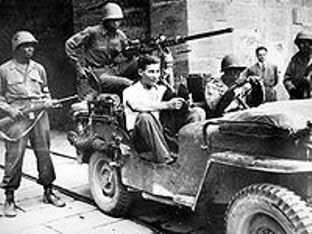
92nd Infantry Division...rounds out US Black Military History


The 92nd Infantry Division was a unit of the United States Army in World War I and World War II. Organized in October 1917 at Camp Funston, Kansas, the unit was formed with African American soldiers from all states. Before leaving for France in 1918, the buffalo was selected as the divisional insignia due to the Buffalo Soldiers nickname, given to African American cavalrymen by Native Americans in the 19th century. The Buffalo Soldiers Division divisional nickname was inherited from the 367th Infantry, one of the first units of the division organized. The 92nd Infantry Division was a part of the 5th Army that served in the Italian Theater during World War II. It was also the only infantry

unit comprised entirely of African Americans, or, as they were referred to at the time – Colored Troops, to see combat in Europe. During their time in Italy, from August of 1944 through the end of the war in May 1945, the 92nd advanced more than 3,000 square miles and captured more than 20,000 German prisoners. They also suffered heavy casualties – with more than a quarter of the unit killed or wounded in action. For their Deeds the 92nd earned more than 12,000 decorations and citations – including two Medals of Honor.


The division was reactivated as an infantry division on 15 October 1942 at Fort Huachuca, Arizona. After two years of training, the 370th Infantry Regiment would be sent overseas in August 1944 and temporarily attached to the 1st Armored Division. The rest of the division would be sent overseas in September of that year, and the division as a whole would see heavy combat during the remainder of the Italian Campaign. Between August 1944 and May 1945 the 92nd Division suffered 3,200 casualties, and the factoring in of losses from the 442nd Regimental Combat Team (442nd RCT) and other units attached to the division brings the total up to 5,000 casualties.


During the division's participation in the Italian Front, the Buffalo Soldiers made contact with units of many nationalities: beyond the attached 442nd RCT, they also had contact with the segregated troops of the British and French colonial empires (Black Africans, Moroccans, Algerians, Indians, Gurkhas, Arab and Jewish Palestinians) as well as with exiled Poles, Greeks and Czechs, anti-fascist Italians and the nonsegregated troops of the Brazilian Expeditionary Force.


92nd Division 1942–1945 was comprised of the following units:

  • 365th Infantry Regiment
  • 370th Infantry Regiment
  • 371st Infantry Regiment
  • 597th Field Artillery Battalion (105mm)
  • 598th Field Artillery Battalion (105mm)
  • 599th Field Artillery Battalion (105mm)


Support Units:


  • 92nd Military Police Platoon
  • 92nd Quartermaster Company
  • 92nd Signal Company
  • 92nd Cavalry Reconnaissance Troop (Mechanized)
  • 792nd Ordnance (Light Maintenance) Company
  • 317th Engineer Battalion
  • 317th Medical Battalion
  • 600th Field Artillery Battalion (155mm)


Attached Units:

  • 366th Infantry Regiment (Nov, 1944 – Feb, 1945)
  • 442nd Infantry Regiment (Nisei) (April 1945 – )
  • 473rd Regimental Combat Team (formed from anti-aircraft units) (February 1945 – May 1945).
  • 758th Tank Battalion (Colored)
  • 679th Tank Destroyer Battalion (Colored)
  • 894th Tank Destroyer Battalion
  • 701th Tank Destroyer Battalion


Task Force 1 (February 1945):

  • 3rd Battalion / 366th Infantry Regiment
  • Company B, 317th Engineer Battalion
  • 760th Tank Battalion
  • 84th Chemical Mortar Battalion (4.2" [107mm])
  • 27th Armored Field Artillery Battalion


    "DEEDS, NOT WORDS"


25th Infantry Regiment


The Twenty-fifth United States Infantry Regiment was one of the racially segregated units of the United States Army known as Buffalo Soldiers. The 25th served from 1866 to 1946, seeing action in the American Indian Wars, Spanish-American War, Philippine-American War and World War II.

After the Civil War, the regular army was expanded to 45 infantry regiments from its wartime strength of 19. The act of Congress that authorized this included the creation of four regiments of "Colored Troops", racially segregated units with white officers and African-American enlisted men. The army had raised a number of volunteer United States Colored Troops (USCT) regiments during the war. The new regiments were the 38th, 39th, 40th and 41st Infantry Regiments, and they set about recruiting mostly from USCT veterans.

By an act of 3 March 1869, Congress reduced the 45 regiments to 25, and the four colored regiments to two. The 39th and 40th Regiments were consolidated and renumbered as the 25th Infantry Regiment. In April the 25th established its first headquarters at Jackson Barracks, Louisiana, under command of Colonel Joseph A. Mower

In World War II the 25th Infantry Regiment (Colored) was an organic component of the 93rd Infantry Division (Colored) and served in the Pacific Theater of Operations. The regiment departed San Francisco on 24 January 1944 and arrived on Guadalcanal in echelons between 7 February and 5 March 1944. From there the regiment was transferred to Bougainville and attached to the Americal Division to take part in offensive operations against Japanese forces on that island in April and May of the same year. From 26 May to 21 June the regiment was stationed on the Green Islands where it received further training and was employed for the construction of defensive fortifications and installations. From 10 November 1944 to 30 March 1945 the 25th Infantry Regiment was involved in defensive actions around Finschafen New Guinea. The regiment's final transfer during World War II was to Morotai Island where it arrived by 12 April 1945 where it once again participated in offensive operations until the end of the war. For World War II the 25th Infantry Regiment (Colored) received campaign credit for the Northern Solomons, Bismarck Archipelago and New Guinea. The regiment was inactivated at Camp Stoneman, California on 3 February 1946, and within a few years, the entire U.S. military was ordered desegregated by President Harry Truman, ending all segregation in the American armed forces.
 

Thursday, February 27, 2014

The 10th Cavalry Regiment aka The "Buffalo Soldiers"


The 10th Cavalry Regiment is a unit of the United States Army. Formed as a segregated African-American unit, the 10th Cavalry was one of the original "Buffalo Soldier" regiments. It served in combat during the Indian Wars in the western United States, the Spanish-American War in Cuba and in the Philippine-American War. The regiment was trained as a combat unit but later relegated to non-combat duty and served in that capacity in World War II until its deactivation in 1944.

The following story is one of many how the Buffalo Soldiers got their name:

In September 1867, Private John Randall of Troop G of the 10th Cavalry Regiment was assigned to escort two civilians on a hunting trip. The hunters suddenly became the hunted when a band of 70 Cheyenne warriors swept down on them. The two civilians quickly fell in the initial attack and Randall's horse was shot out from beneath him. Randall managed to scramble to safety behind a washout under the railroad tracks, where he fended off the attack with only his pistol until help from the nearby camp arrived. The Indians beat a hasty retreat, leaving behind 13 fallen warriors. Private Randall suffered a gunshot wound to his shoulder and 11 lance wounds, but recovered. The Cheyenne quickly spread word of this new type of soldier, "who had fought like a cornered buffalo; who like a buffalo had suffered wound after wound, yet had not died; and who like a buffalo had a thick and shaggy mane of hair."

They participated in the Indian Wars from 1866-1898; The Spanish-American War; Philippine American War; Mexican Expedition; WWI; WWII; Vietnam and OIF.

In 1958 the Regiment was reactivated. 1st Squadron, 10th Cavalry was assigned to Fort Lewis, Washington on September 1, 1963 as the eyes and ears of the 4th Infantry Division. It received its first Valorous Unit Award in May 1969 for actions at LZ Oasis against a battalion sized enemy force. 2nd Squadron, 10th Cavalry was activated on 1 July 1957 and consolidated with the 7th Recon Company transferring less personnel and equipment to Korea from Germany. It was assigned to the 7th Infantry Division. It was transferred with 7th Division to Fort Ord, California in December 1976. 2nd Squadron, 10th Cavalry (Air) served as the 7th Division's helicopter borne reconnaissance asset. It had a scout troop (Kiowa), Lift Troop (Huey), Attack troop (Cobra) and a ground troop of scouts in jeeps. The Squadron was reorganized in August 1985 as a Reconnaissance Squadron under the Infantry Division (Light) configuration. The unit was deactivated and replace by an element of the 9th Cavalry prior to the 7th Divisions eventual de-activation and depart from Fort Ord.

Wednesday, February 26, 2014

9th Cavalry Regiment "We Can, We Will"


The regiment was constituted 28 July 1866 in the Regular Army as Company F, 9th Cavalry. On 3 August 1866, Major General Philip H. Sheridan, commanding the Military Division of the Gulf, was "authorized to raise, among others, one regiment of colored (African-American) cavalry to be designated the 9th Regiment of U. S. Cavalry".

The regiment was organized on 21 September 1866 in New Orleans, Louisiana, and mustered between September 1866 and 31 March 1867. Its first commanding officer was Colonel Edward Hatch. The men enlisted for five years and received $13 per month, plus room, board and clothing. Later they were dubbed "Buffalo Soldiers". The regiment's motto was, and remains, "We Can, We Will".

The mustering, organized by Maj. Francis Moore, 65th U. S. Colored Infantry, formed the nucleus of the enlisted strength, and was obtained from New Orleans and its vicinity. In the autumn of 1866 recruiting was also established in Kentucky, and all the men of the 9th were obtained from that state and Louisiana. The horses were obtained at St. Louis, Missouri. About the middle of September all recruits were assembled in New Orleans, where empty cotton presses were used as barracks. An epidemic of cholera caused the camp to be moved to Carrollton, a suburb of New Orleans. By the end of March 1867, the 9th Cavalry was at nearly full strength with a total of 885 enlisted men, or an average of over 70 to a troop, and was ordered to San Antonio, Texas, where it arrived early in April for three months of training. However, Troops L and M went directly to their duty station at Brownsville, Texas.

The Regiment saw action in Indian Wars, Spanish-American War, WWI, WWII, Vietnam as Air Cav, Operation Just Cause and Operation Iraqi Freedom.

During OIF, Troop B ("Bloody Knife"), 9th Cavalry, 3rd Brigade, 4th Infantry Division, was deployed from Fort Carson, Colorado, to Iraq in April 2003. After arriving at Camp Wolfe, Kuwait the unit moved to Camp New Jersey in Northern Kuwait. The lead elements of the Brigade Reconnaissance Troop (BRT) then crossed into Iraq, covering a distance of over 300 kilometers. This combat operation was the first for the 4th Infantry Division since Vietnam. The BRT has operated in Samarra East Airfield, Samarra, Ad Dawr, Tikrit East, Tuz Khurmat, Jalula, MEK, Daquq, Kirkuk, Taza Khormatu, Al Huwayjah, Ad Duluyah, At Tarmyia, Ad Dujayl, and Balad South.
On 23 October 2003, the soldiers of Troop B/9th Cavalry were issued their combat patches (e.g., the authorization to wear the division patch on the right shoulder) for conducting combat operations in support of Operation Enduring Freedom and Operation Iraqi Freedom. The troop consisted of two platoons of scouts and one platoon of COLT (combat observation lasing Teams). The unit deployed under the command of CPT William Sachse and redeployed under the command of CPT Clinton Fuller. The Bloody Knife Troop became the quick reaction force for one of the largest logistics bases in Iraq while still conducting operations where ever the brigade needed them. The unit had several platoon leaders rotate in and out but maintained its platoon sergeants from start to finish during OIF 1. 1st Platoon - SFC Olvera, 2nd Platoon - SFC Baird, and 3rd Platoon - SFC Noga. The Bloody Knife Troop was one of the last reconnaissance troops to fall directly under a brigade headquarters.


Tuesday, February 18, 2014

2nd Ranger Infantry Company (Airborne)


The 2nd Ranger Infantry Company (Airborne) was a Ranger light infantry company of the United States Army active during the Korean War. As a small special operations unit, it specialized in irregular warfare. A segregated unit, all of its personnel, including its officers, were African-Americans.

Activated and trained as a successor organization to the 2nd Ranger Battalion from World War II, the 2nd Ranger Company was formed and trained extensively in airborne warfare. Deployed to South Korea in December 1950, the company quickly adopted the motto of "Buffalo Rangers" and worked extensively as a scouting force for the U.S. 7th Infantry Division. In this role, the company undertook several major operations against the Chinese People's Volunteer Army, including Operation Tomahawk in early 1951.

Even though racial politics often resulted in the company receiving untrained replacements, it performed well in many small-scale engagements during this time. In the summer of 1951, the company was employed along the front line as an advance force to push back Chinese attacks as the front lines became more static. The company was highly regarded for its actions capturing and holding Hill 581 during the Battle of the Soyang River, in which the company inflicted hundreds of casualties on the Chinese without a single Ranger being killed.

Disbanded in August 1951 along with all the other Ranger companies, the unit's soldiers accrued several awards in its 10-month existence. These included four campaign streamers, nine Silver Star Medals and over 100 Purple Heart Medals. Subsequent research has focused on the economy of force of how the Rangers were employed and how their performance was impacted by the racist policies of their time.

The U.S. Army, which up until that point typically did not allow African-American soldiers to serve in special forces units, authorized African-Americans to apply to become Rangers. However, in spite of Executive Order 9981, which had de-segregated the U.S. military in 1948, the Army opted to pool all black applicants into one company. By 1950, most units were still de facto segregated, and in the 82nd Airborne Division, Ranger applicants came from the all-black units including the 3rd Battalion, 505th Airborne Infantry, the 758th Tank Battalion and the 80th Anti-Aircraft Artillery Battalion. Many of the applicants were World War II veterans who had seen combat, and many others had served with the 555th Parachute Infantry Battalion.

Of a pool of 5,000 applicants, on 2 October the Ranger Training School selected 22 officers and 314 enlisted men for the first three Ranger companies, which were entirely white. A fourth, all African-American company was organized several days later. The 2nd Ranger Infantry Company (Airborne) was organized on 9 October 1950, assuming the lineage of A Company of the 2nd Ranger Battalion.  It had an initial strength of 135 enlisted men and 5 officers under the command of First Lieutenant Warren E. Allen, company commander, and Second Lieutenant James C. Queen, executive officer.[20] Originally it had been designated the 4th Ranger Infantry Company (Airborne), but the two companies switched designations, apparently to prevent accusations of racial discrimination. The unit was formally activated on 25 October 1950 at Fort Benning.

The Rangers trained extensively in reconnaissance, long-range patrols, motorized scouting, setting up roadblocks, land navigation, camouflage, concealment, and adjusting indirect fire. They undertook frequent live fire exercises, many at night, simulating raids, ambushes and infiltrations. The Rangers trained 60 hours per week and ran 5 miles (8.0 km) each day and frequently held 20 miles (32 km) speed marches, which were considered traditions for Ranger training from World War II. The training for the numbered companies included much of the program used by Second Lieutenant Ralph Puckett to train the Eighth Army Ranger Company. In spite of a 30 percent dropout rate, most of the men completed the course and graduated on 15 November 1950. The Rangers left Fort Benning on 3 December and traveled to Camp Stoneman, California, with the 4th Ranger Company. They sailed for Japan on 9 December aboard the transport USS General H.W. Butner bound for the front lines in the Korean War. The company arrived at Yokohama, Japan, on 24 December, and was flown from Tachikawa Air Base to Taegu five days later.

Arriving in Korea on 30 December, the 2nd Ranger Company was attached to the 32nd Regimental Combat Team, 7th Infantry Division, X Corps which was regrouping in Yonchon having been badly mauled in the Battle of Chosin Reservoir, a battle which signaled the unexpected entry of Chinese troops into the war

On 28 February 1951, the 2nd Ranger Company was attached to the 187th Airborne Regimental Combat Team (RCT), alongside the 4th Ranger Infantry Company, and began unit training jumps and tactical exercises in preparation for a combat parachute drop. These exercises continued throughout March 1951, as much of the UN force conducted the aggressive Operation Ripper as a large-scale counteroffensive against the Chinese and North Korean force. To follow-up this attack, Lieutenant General Matthew Ridgway, commander of the Eighth Army, planned Operation Tomahawk, a mission to insert the 187th RCT and the Rangers behind the Chinese lines to cut off Chinese supplies and force them to retreat north of Seoul. During the three weeks of training, the Rangers were reinforced by another platoon of African-American Rangers directly from Ranger school under Lieutenant Antonio Anthony. On 23 March, the 187th and attached Rangers were dropped around Munsan-ni, 24 miles (39 km) northwest of Seoul, with the mission to hold an airhead to interfere with the Chinese and North Korean logistical network, and linkup with the 6th Medium Tank Battalion 18 hours after drop.

As a result of the decision to disband the Ranger units, the 2nd Ranger Company was deactivated on 1 August 1951 while it was still in Korea. Like many of the other Ranger units, most of the 2nd Ranger Company veterans were folded into the 187th RCT. As an airborne unit, it was believed that by sending the men to the 187th, their airborne skills could be used. Nevertheless, in the end it turned out that Operation Tomahawk was the last airborne jump of the war and as a result, the former Rangers did not get a chance to exercise these skills again. Nine Rangers received Silver Star Medals and 11 received Bronze Star Medals. A total of 103 Purple Heart Medals were awarded to 84 members of the company, with 11 Rangers receiving two Purple Hearts and four Rangers receiving three.